Yeast from Urine

by Boudewyn van Oort

In my book I say very little about the men’s camp, Tjimahi, where my father was interned. These two pictures however are referred to (but are not reproduced) in the book.

Some clever chemist in the men’s camp had worked out a process for producing a liquid yeast from urine. This discovery has been immortalized in these two pictures.
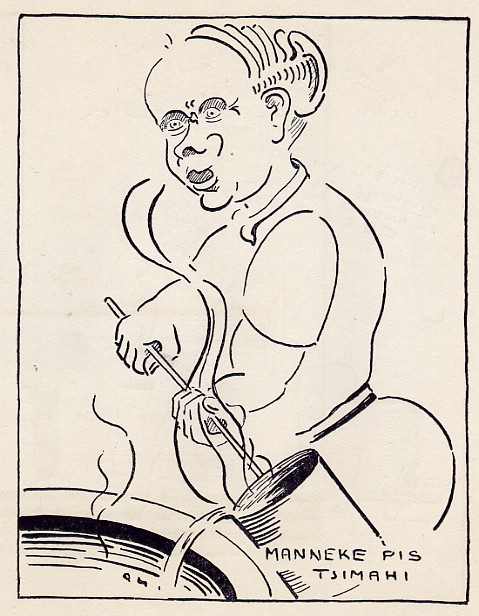
One is an image of the presumed chemist, also referrred to in the caption as “manneke pis”.  That name would have been familiar to anyone living or growing up in the Netherlands or Belgium. In a corner of the Grand Place of Brussels there stands a  bronze statue of a little boy (it is also a little statue- half a meter tall) peeing day and night, and that statue has the same name. It is a relic from World War 1 and was erected by a company of soldier who had befriended the boy- probably an orphan.
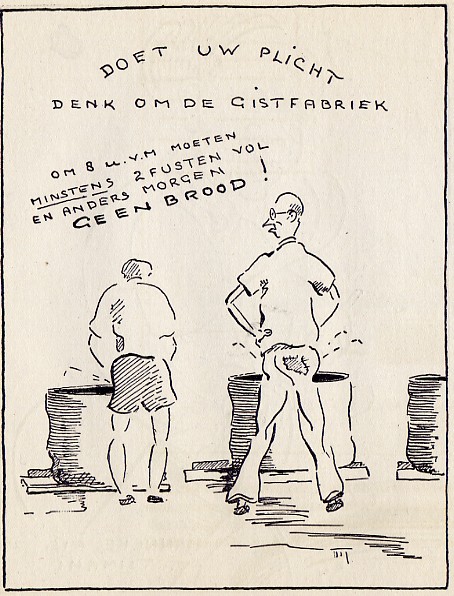
The other caption says something to the effect of : “Do your duty gentlemen, otherwise no bread tomorrow.” For about six months our women’s camp received a daily supply of this yeast for breadmaking from Tjimahi (about 10 km away). It was delivered on the back of an improvised  truck made by replacing the rear end of an automobile with a flat bed, and contained in one or two 45 gallon drums.

The cartoons were drawn by M.G. Hartley between 1942 and 1945.

These images relate to Bandung and our time there. We were first interned in the city where we were living, Bandung, and only in May 1945, shortly before the end of the war, were moved to Batavia ( Jakarta) and the Tjideng Camp.

{ 4 comments… read them below or add one }

felicity baker 02.16.09 at 7:31 am

Howard mentions this in his book ‘Nanyo’ (unpublished unfortunately): the inventor of the bread yeast was Baron van Boetzelaer, known as “Boots”. After the oil company Bataafsche Petroleum Maatschappij (AKA “Shell”) he called his process BPM (Baros Piss Mij). He got from the Japanese several giant bamboo cylinders, cut under a joint, and of a 5-6″ diameter and about a metre long. These were placed in the latrines for men to pee in, and when they were full he emptied them into a larger container in the “lab” and heated to concentrate or crystallise in some way to obtain the ‘yeast’. Howard had no idea that the yeast was transported to the women’s camp!
Regards
Felicity

felicity baker 02.16.09 at 8:07 am

Sorry, forgot to say Howard mentions MG Hartley in his ‘memory list’ of Tjimahi POW’s. He first met him in Soekamiskin. Did you ever see Hartley’s book Mijn Kamp?
Felicity

Boudewyn van Oort 02.16.09 at 10:35 am

This is priceless information. Dr Piss finally identified! I was fortunate to be able to find a copy of Hartley’s book of cartoons. My father died in 1990 and took with him much information to the grave. What he told me is in the book, Tjideng Reunion. The NIOD in Amsterdam published a book called “De Japanse bezetting in dagboeken: Kamp Tjimahi 4″, but it had too little information to allow me to relate any of it to what Dad told me. The archives in the Hague may have some information (Nationaal Archief).

Is there a way of getting Howards book published?

B 16 Feb 2009

Donald Robin Hartley 03.17.11 at 1:17 pm

My father was Mervyn Gilbert Hartley and thus author of the book Myn Kamp of which both my sisters, Hope Hartley, Gillian Hartley and myself have a copy. After the war we were lucky to move out to Southhampton by boat and from there to Amsterdam in Holland. From Holland we emigrated in 1952 to Argentina to the most northern province called Jujuy, where my father being a sugar technologist worked for many years in a sugar factory named Ingenio La Esperanza.
Of course we have heard many stories about the camp life, from where all of us after almost four years under the ruling of the Japanese survived and were able to gather again and start a new life in Holland.
It would be interesting to hear from you Boudewyn. Best regards Donald

Leave a Comment

You can use these HTML tags and attributes: <a href="" title=""> <abbr title=""> <acronym title=""> <b> <blockquote cite=""> <cite> <code> <del datetime=""> <em> <i> <q cite=""> <strike> <strong>