Posts tagged as:

Internment

Communal Kitchen at Tjihapit

Communal Kitchen at Tjihapit

This drawing of the communal Tjihapit camp kitchen was made by Lieske Stroobach on 4 October 1944.

{ 1 comment }

In my book I say very little about the men’s camp, Tjimahi, where my father was interned. These two pictures however are referred to (but are not reproduced) in the book.

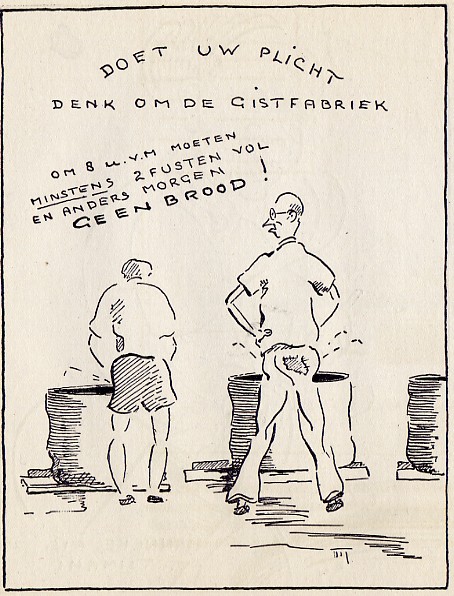
Some clever chemist in the men’s camp had worked out a process for producing a liquid yeast from urine. This discovery has been immortalized in these two pictures.

One is an image of the presumed chemist, also referrred to in the caption as “manneke pis”.  That name would have been familiar to anyone living or growing up in the Netherlands or Belgium. In a corner of the Grand Place of Brussels there stands a  bronze statue of a little boy (it is also a little statue- half a meter tall) peeing day and night, and that statue has the same name. It is a relic from World War 1 and was erected by a company of soldier who had befriended the boy- probably an orphan.

The other caption says something to the effect of : “Do your duty gentlemen, otherwise no bread tomorrow.” For about six months our women’s camp received a daily supply of this yeast for breadmaking from Tjimahi (about 10 km away). It was delivered on the back of an improvised  truck made by replacing the rear end of an automobile with a flat bed, and contained in one or two 45 gallon drums.

The cartoons were drawn by M.G. Hartley between 1942 and 1945.

These images relate to Bandung and our time there. We were first interned in the city where we were living, Bandung, and only in May 1945, shortly before the end of the war, were moved to Batavia ( Jakarta) and the Tjideng Camp.

{ 4 comments }

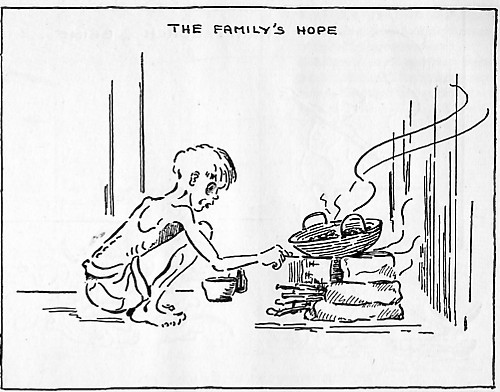
As I got older during my internment period, I began to fear the day I would become ten years old, for that meant, becoming independent and leaving the care of my mother. I of course had no idea what such an experience would mean for me, and that may be just as well because the truth of what happened to these youngsters defies belief. Those who physically survived the experience never recovered from the psychological damage.

I was lucky and celebrated my tenth birthday after the war.

Mr. Hartley (Myn Kamp, niet door Hilter, Amsterdamsche Boek en Courant Maatschappij, 1947), who drew this cartoon of one such pathetic youngster who happened to be interned in Tjimahi, a Men’s camp where my father also was, gave the experience a bitter twist.

His caption reads: Many a mothers’ heart would have swelled with pride had she been able to see her dear son’s culinary achievements. It was not just that the raw materials had been obtained via devious means, but the provision of fuel would likely have involved even less elegant techniques: chairs, tables,  windows, wooden shoes, all sacrificed for a meal.

{ 0 comments }

The Velo: Our Camp Ambulance

The “Velo” was a creation of some teen age boys in the Tjihapit camp. This was our camp ambulance.  Rollo Hansen, the son of a colleague of my father is credited with the invention. The sketch was drawn after the war by H. Liesker, a fellow teenage Tjihapit camp internee.  Within a year these older teen age boys had been evicted from the camp: some were lucky to be reunited with their fathers, many others ended up looking after themselves.

{ 4 comments }