Posts tagged as:

Tjihapit

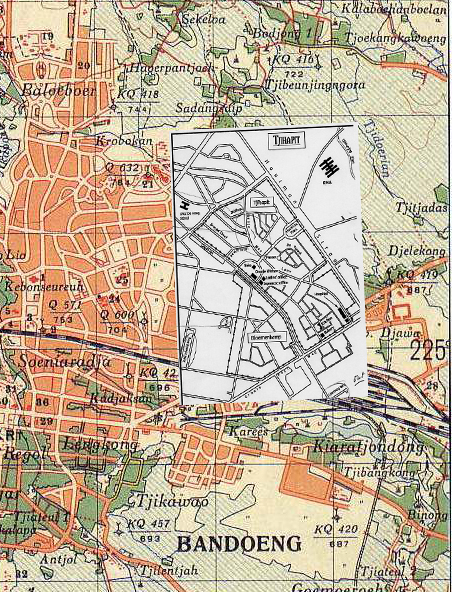
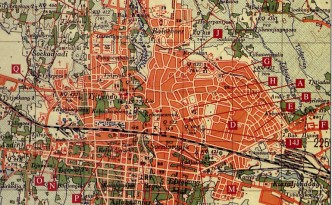
This prewar map shows the surroundings of Bandoeng (Bandung). It is dated around 1937.

The Tjihapit district lay along the north eastern edge of town.
Included in the book, Tjideng Reunion, is this detailed map of the camp itself.

To clarify the position of the camp, comparison of the two images makes the location obvious because of the curious road layout.

{ 1 comment }

Sone Tribunal
Sone Tribunal

Sone, our Camp Commandant on trial for war crimes in Singapore. He was convicted and executed.

Photo from NIOD ( Netherlands Institute of War Documentation)

{ 2 comments }

Dress Rehearsal
Dress Rehearsal

Dress Rehearsal: Prior to the first group of internees being shipped out of Tjihapit for destinations unknown to themselves, the Japanese Camp Commandant needed to satisfy himself that no forbidden items such as books of any description remained in the possession of internees, and that the weight limit of luggage was not exceeded. Hence a dry run (or dress rehearsal) was organized.

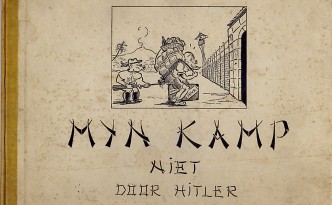
A cartoon of Tjihapit life drawn by Adri Bontekoe

{ 2 comments }

Communal Kitchen at Tjihapit

Communal Kitchen at Tjihapit

This drawing of the communal Tjihapit camp kitchen was made by Lieske Stroobach on 4 October 1944.

{ 1 comment }

Murui and Tetsuka Dressed as Women

Murui and Tetsuka, two Japanese guards, tried to lay a trap for catching women conducting forbidden trade for food through the bamboo camp wall.

A cartoon of Tjihapit life drawn by Adri Bontekoe

{ 0 comments }

Appel or Tenko
Appel or Tenko

Appel or Tenko: When we came under direct Japanese military supervision twice daily headcounts were conducted. This became a source of immense frustration and always was accompanied by confusion.

A cartoon of Tjihapit life drawn by Adri Bontekoe

{ 2 comments }

The Velo: Our Camp Ambulance

The “Velo” was a creation of some teen age boys in the Tjihapit camp. This was our camp ambulance.  Rollo Hansen, the son of a colleague of my father is credited with the invention. The sketch was drawn after the war by H. Liesker, a fellow teenage Tjihapit camp internee.  Within a year these older teen age boys had been evicted from the camp: some were lucky to be reunited with their fathers, many others ended up looking after themselves.

{ 4 comments }

Punishment for trading through the camp wall

Punishment: washing the floor in the “gentlemen’s office” was the least obnoxious form of punishment. In this case for the crime of trying to conduct illegal trade through the camp wall.

A cartoon of Tjihapit life drawn by Adri Bontekoe

{ 0 comments }

Boudewijn van Oort and his Mother

This photograph of the author and his mother was taken in Tjihapit camp for women and children, 1943.

{ 5 comments }